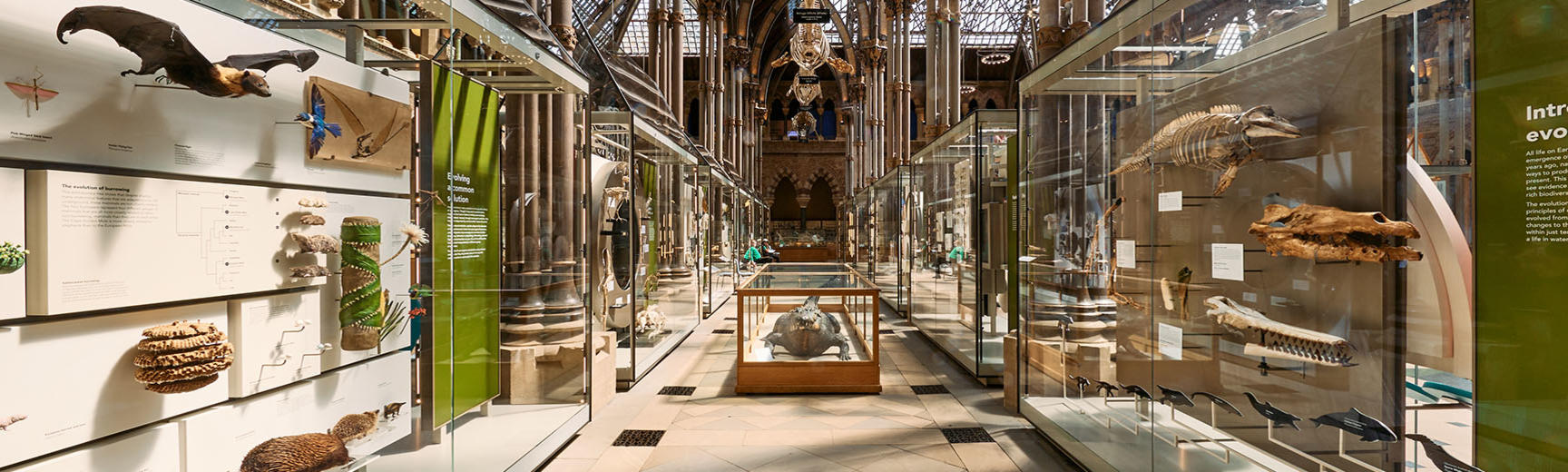
How has evolution shaped life on Earth?
This taught session uses museum specimens and displays to explore how evolutionary processes have shaped the diversity of life on Earth.
Students will apply key biological concepts including variation, inheritance, natural selection, adaptation and evolution, while examining real-world evidence that supports our understanding of evolutionary change.
Through practical activities, close observation and discussion, students will explore:
- Variation and survival – how variation within populations can affect an organism’s ability to survive, compete and reproduce.
- Natural selection and adaptation – how individuals with advantageous characteristics are more likely to survive and reproduce, passing on the alleles associated with these characteristics. Over many generations, this can lead to populations becoming better adapted to their environments.
- Evolution and biodiversity – how genetic variation and natural selection can result in evolutionary change over generations, contributing to the diversity of living organisms.
- Evolution as a scientific theory – what we mean by a scientific theory, and how theories are developed, tested and supported by evidence. Students will consider how new evidence can contribute to, refine or challenge scientific explanations.
Science Learning Outcomes
By the end of the session, students will be able to:
- Explain how variation within a population can affect survival and reproduction.
- Describe how natural selection can lead to changes in populations over generations.
- Explain how adaptations can increase an organism’s chances of survival and reproduction.
- Describe how evolution contributes to biodiversity.
- Identify and interpret different types of evidence for evolution, including fossil, genetic and anatomical evidence.
- Explain the difference between a scientific idea and a scientific theory, and understand how theories are supported by extensive evidence.
- Recognise how we collect evidence, test explanations, evaluate data and refine scientific theories.
Museum Learning Outcomes
Students will also develop their ability to carefully handle and observe museum specimens, use observations to ask scientific questions and make evidence-based interpretations, and understand how museum collections are collected, preserved, researched and used as evidence to investigate biodiversity, evolution and changes in life on Earth.