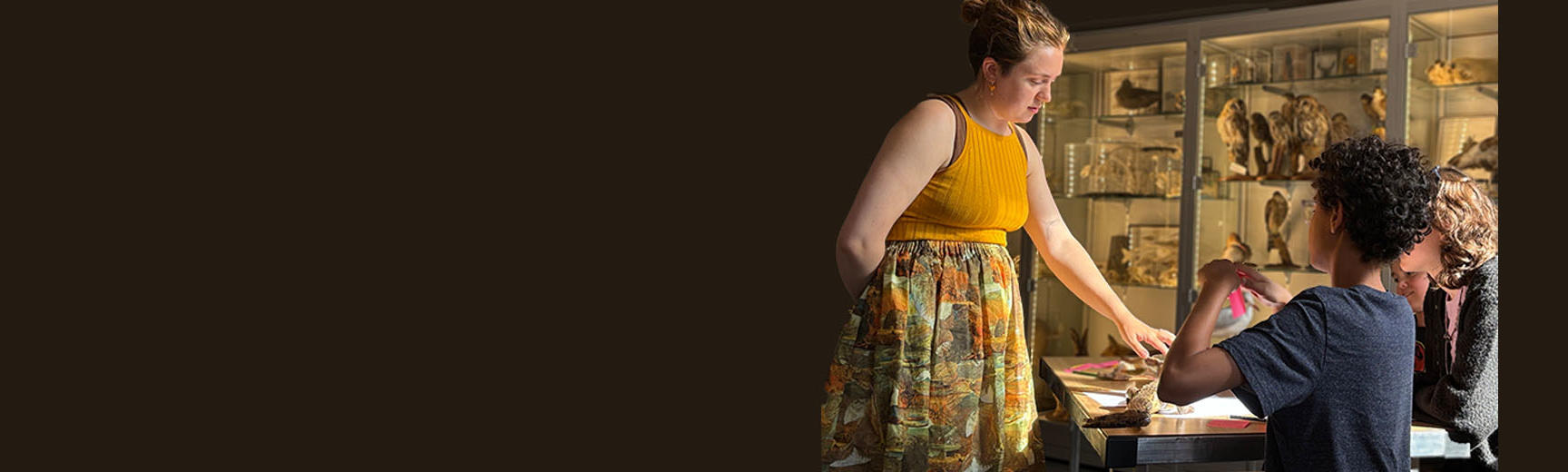
As I take the emperor goose out of the cabinet, I feel that familiar thrill of childlike glee I get whenever I handle specimens. I’ve never seen an emperor goose in the wild, and likely never will, but here in the museum I am close enough to see each snow-white feather on its head. And for the teenagers attending our programmes, I hope the raft of specimens we’re putting out today will elicit a similar excitement; a chance to rapturously indulge their naturalist’s curiosity, peering at the shape of claws, feeling the fur of wild animals and drinking in the wonderful strangeness of nature.
I’ve always loved natural history museums, so when the opportunity came up to help run part of Oxford University Museum of Natural History's youth programme, I couldn’t believe my luck. I’m a botanist by training, but like many museum folk, it’s the diversity of the natural world which really enthrals me. So, I decided one of my first sessions would be on how we name and categorise species. Whatever animals, plants or fungi you work with, they are all classified through a universal system known as the taxonomic hierarchy. This tells us which species are more closely related to each other, and what characteristics are typical of different groups. This system is continually evolving, as our understanding of the relationships between species changes, but it’s still an essential tool which allows us to collaborate across languages and time periods. There are species whose common name varies hugely between regions, but its Latin name remains the same. This also informs how we go about identifying new specimens; in our session, the students built their own dichotomous keys, attempting to categorise an intentionally chaotic array of specimens. Does it have fur or scales, wings or paws, teeth or a bill? What groups have you ended up creating as a result?
Like a lot of my colleagues, I feel a tiny burst of awe every time I walk into the museum. I imagine the countless visitors who have walked through these doors for over 100 years feel it too. It’s a chance to tour the natural world under one roof; brushing past a black bear, locking eyes with a shoebill or measuring yourself against an extinct Irish elk. Whenever I speak to people, it is always my aim to demystify science, to show the often simple ideas behind the front of exclusivity, and to make people feel like they’re welcome in this nerdy club. And what Devika and Sarah have built in the youth programme is the most wonderful nerdy club of all, and I feel very lucky to have spent a year being a part of it.