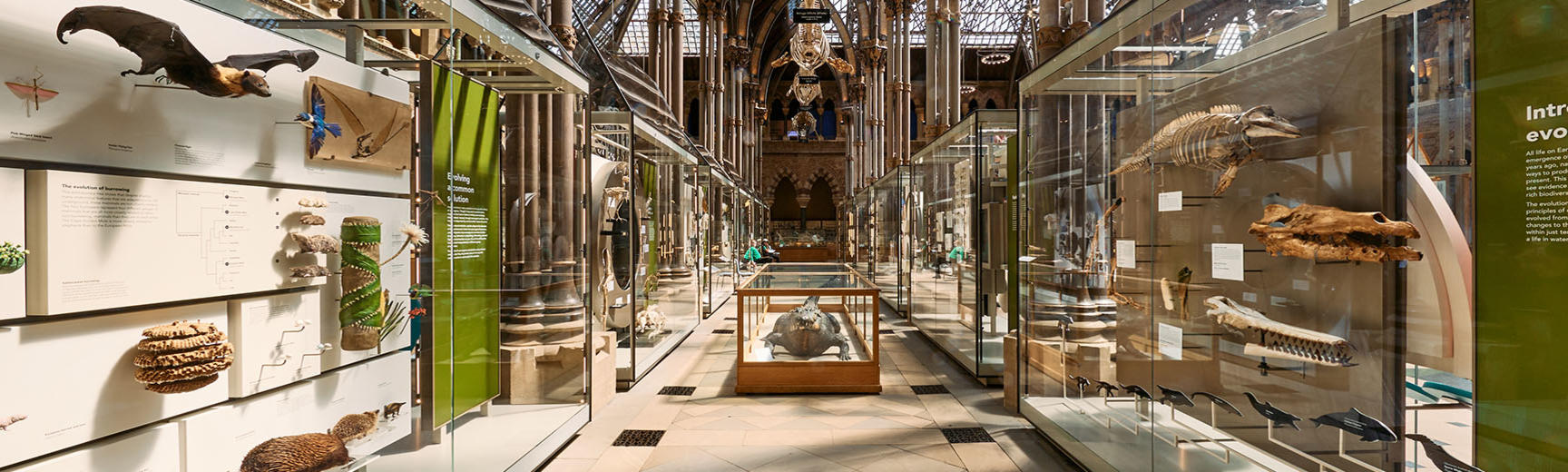
This taught session uses museum specimens and displays to explore how evolutionary processes have shaped the diversity of life on Earth.
Students will explore how genetic variation, selection pressures, natural selection and adaptation interact to drive evolutionary change within populations. They will examine different patterns of selection, including stabilising, directional and disruptive selection, and consider how these processes can contribute to adaptation and biodiversity over successive generations. Students will explore:
Variation and survival
How genetic variation within populations can result in differences in phenotype, and how these differences may affect an organism’s ability to survive, compete and reproduce.
Selection pressures and adaptation
How selection pressures influence the survival and reproductive success of individuals within a population. Students will consider how individuals with advantageous heritable characteristics are more likely to survive and reproduce, increasing the frequency of associated alleles over generations and potentially leading to populations becoming better adapted to their environments.
Natural selection, evolution and biodiversity
How changes in allele frequencies within populations over generations can result in evolutionary change. Students will explore how different patterns of natural selection, including disruptive selection, can contribute to divergence and the diversity of life.
Science Learning Outcomes
By the end of the session, students will be able to:
Explain how genetic and phenotypic variation within a population can affect survival and reproductive success.
Describe how selection pressures can result in changes in allele frequencies within populations over successive generations and lead to adaptation and evolutionary change.
Describe how evolutionary processes contribute to biodiversity.
Identify, interpret and evaluate different lines of evidence for evolution, including fossil, anatomical and genetic evidence.
Explain the distinction between a scientific idea and theory, and understand how scientific theories are supported by extensive evidence.
Museum Learning Outcomes
Students will also develop their ability to:
Interpret museum specimens as sources of evidence for biodiversity, evolution and changes in life on Earth.
Appreciate the role of museum collections in providing evidence that helps us investigate evolutionary relationships, biodiversity and the history of life on Earth.